Labreels Team
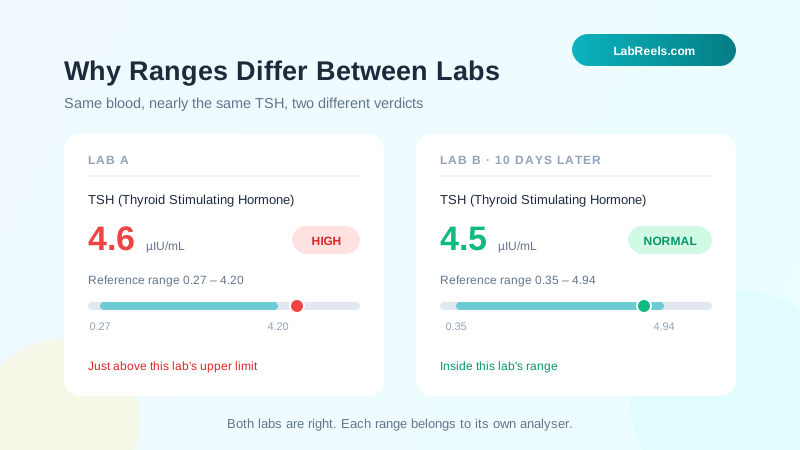
Meena is 44 and teaches maths at a school in Jaipur. Her annual checkup at a hospital lab showed a TSH of 4.6, printed against a range of 0.27–4.20 and marked High. Worried about her thyroid, she repeated the test ten days later at a diagnostic centre near home. This time the TSH was 4.5, the range read 0.35–4.94, and there was no flag at all.
Same woman, same thyroid, almost the same number. One report called it abnormal and the other called it normal. Her first thought was that one of the labs had made a mistake.
Neither had. Both ranges are correct for the equipment that produced them. Each lab sets its own reference range, for reasons that make complete sense once you know them. This guide covers the five main reasons, which tests vary the most, and how to compare reports from two labs.
Key Takeaways
- A reference range is the span where the middle 95% of healthy people fall, so about 1 in 20 healthy people will land outside it on any single test
- Ranges differ between labs for five reasons: the machine and method, the reference population, age and sex splits, units, and which expert cut-offs the lab chooses to print
- Always read your result against the range printed on the same report, never against a range from another lab or the internet
- TSH, Vitamin D, ALP and creatinine vary the most between labs. HbA1c and cholesterol vary the least because their testing is standardised internationally
- To track a value over time, stick to one lab when you can, and bring every report to your doctor
What Is a Reference Range, and Who Decides It?
A reference range, printed on many Indian reports as the "biological reference interval", is the span of results seen in healthy people. It is not a line between health and disease. It describes what healthy people usually look like on that test.
To build one properly, a lab tests a group of healthy volunteers and keeps the middle 95% of their results. The lowest 2.5% and the highest 2.5% sit outside the range by definition, even though those people are perfectly well. The international standard for this process, from the Clinical and Laboratory Standards Institute, calls for at least 120 healthy people for each group the range describes, such as 120 men and a separate 120 women.
Recruiting hundreds of healthy volunteers for every test is expensive, so very few labs do it themselves. Most take the range supplied by the company that makes their analyser and test it on a small group of local healthy people, typically 20. If no more than 2 of those 20 fall outside, the lab adopts the range. This is sound, accepted practice. It also means your lab's range is really the manufacturer's range, built on the manufacturer's volunteers and tied to the manufacturer's chemistry.
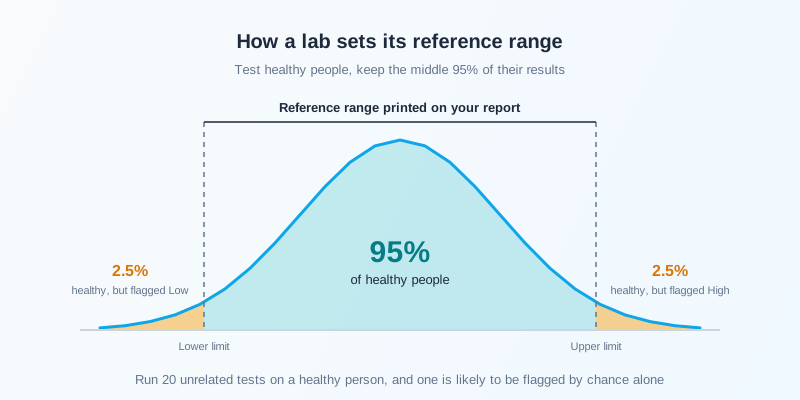
The 95% rule has a consequence worth knowing. Run 20 unrelated tests on a perfectly healthy person, and there is roughly a 64% chance at least one comes back flagged. That is why MedlinePlus reminds patients that a result outside the range does not automatically mean something is wrong, and why an "abnormal" flag is a statistical term, not a diagnosis.
Why Do Reference Ranges Differ Between Labs?
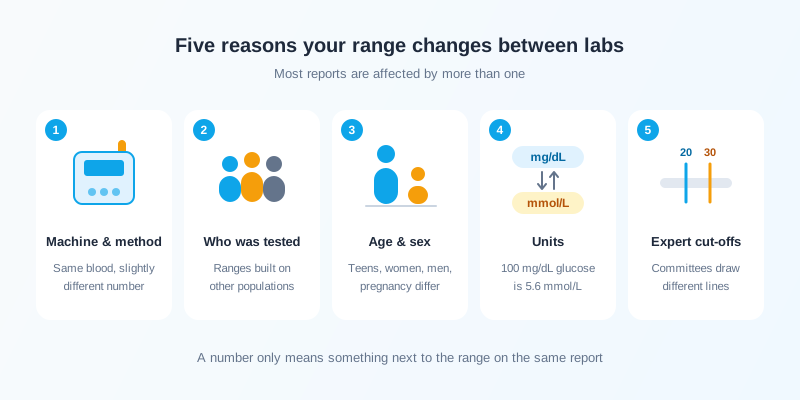
Five things change the range printed beside your result, and most reports are affected by more than one. We touched on this briefly in why lab reports look so confusing. Here is the full picture.
1. Different Machines Measure the Same Blood Differently
This is the biggest reason, and the one behind Meena's TSH. Indian labs use analysers from several global manufacturers, and each uses its own chemistry, antibodies and calibration. Run one blood sample on two different machines and you will often get two slightly different numbers, so each manufacturer publishes a range that matches its own method.
Hormone tests are the most affected, because each manufacturer designs its own antibodies to detect the hormone. TSH is the textbook case: the upper limit printed on Indian reports falls anywhere from about 4.2 to 5.5 µIU/mL depending on the analyser. Vitamin D is another. Vitamin D tests from different makers have given inconsistent results on the same blood sample, which is why the US National Institutes of Health launched a programme in 2010 just to standardise them.
Routine tests are affected too. Creatinine, the main kidney marker, is measured by two different chemical reactions in Indian labs, the older "Jaffe" method and the newer "enzymatic" one, and they read slightly differently, especially at low levels.
A number only means something next to the range from the same machine. Judging one lab's result against another lab's range is measuring with one ruler and reading off another.
2. The Range Was Built on a Different Population
A range is only as good as the people used to build it. Many ranges supplied with analysers come from studies done abroad, on volunteers whose diet, body size, muscle mass and genetics differ from yours. Until 2018 India had no well-designed reference range study at all. When a multi-centre IFCC study finally measured 33 common tests in 512 healthy Indians, it found that age and body weight shifted many results, and that 17 tests, including cholesterol, liver enzymes, creatinine and uric acid, needed separate ranges for men and women.
Two everyday examples show why this matters. Creatinine is made by muscle, so a smaller person with less muscle mass naturally runs a lower creatinine, and a range built on larger volunteers can hide an early rise. Hemoglobin rises with altitude, because the body makes more red cells when air is thinner, which is why WHO's 2024 anaemia guideline adjusts hemoglobin for people living at altitude and for smokers.
3. Age, Sex and Pregnancy Need Their Own Ranges
Some tests change so much across life that one adult range cannot cover everyone. A large lab may print separate ranges by age and sex, while a smaller lab may print one adult range for everybody.
- Alkaline phosphatase (ALP) comes partly from growing bone, so it can be two to three times higher in teenagers than in adults. A healthy 14-year-old can look alarming on an adult range.
- Hemoglobin and creatinine run higher in men than in women, so a single shared range is too loose for one and too tight for the other.
- TSH targets are lower in pregnancy and are ideally set separately for each trimester.
If your report prints one range for a test that depends on age or sex, ask your doctor whether it fits you.
4. Units Change the Numbers Completely
Before comparing two results, check the units. The same blood can be written as very different numbers depending on the unit a lab uses, and the range changes with it.
| Test | Same result, common Indian unit | Same result, international (SI) unit |
|---|---|---|
| Fasting glucose | 100 mg/dL | 5.6 mmol/L |
| Creatinine | 1.0 mg/dL | 88 µmol/L |
| Total cholesterol | 200 mg/dL | 5.2 mmol/L |
| Hemoglobin | 13 g/dL | 130 g/L |
| Vitamin D | 20 ng/mL | 50 nmol/L |
| Platelets | 2.5 lakh/µL | 250 × 10⁹/L |
Most Indian labs report in mg/dL, but hospitals abroad and some Indian labs use SI units. A cholesterol of 5.2 is not dangerously low. It is 200 mg/dL written another way.
5. Some "Ranges" Are Really Expert Cut-offs
Not everything printed in the range column comes from healthy volunteers. For some tests, the line is a clinical decision limit: a threshold chosen by an expert committee because risk rises beyond it. Fasting glucose (100 and 126 mg/dL), HbA1c (5.7% and 6.5%) and LDL cholesterol targets all work this way.
Here labs differ because they follow different committees. Vitamin D is the clearest example. The US Institute of Medicine committee considers 20 ng/mL enough for bone health in 97.5% of people, while the Endocrine Society's 2011 guideline treated anything under 30 ng/mL as insufficient. So one Indian lab prints 30–100 ng/mL as "sufficient" and another prints 20–50. A result of 24 ng/mL is "insufficient" on the first report and adequate on the second. The blood has not changed. The committee has.
Cholesterol works the same way. The "desirable" LDL printed on most reports is a general cut-off, while Indian cardiology bodies set stricter targets based on your personal heart risk.
Which Tests Vary the Most Between Labs?
| Test | How much the printed range varies | Main reason |
|---|---|---|
| TSH | Upper limit from about 4.2 to 5.5 µIU/mL | Different antibody methods |
| Vitamin D | "Sufficient" starts at 20 or at 30 ng/mL | Labs follow different guidelines |
| ALP | Adult upper limit roughly 100 to 150 U/L, far higher for teenagers | Method, age and sex |
| Creatinine | Upper limit roughly 1.1 to 1.3 mg/dL in men | Method and muscle mass |
| Hemoglobin | Separate ranges for men and women, limits shift slightly | Sex, population, altitude |
| Platelets and WBC | Same range written in different units | Units |
| HbA1c | Nearly identical at certified labs | Internationally standardised |
| Total cholesterol and LDL | Nearly identical | Standardised methods and guideline cut-offs |
The reassuring news sits at the bottom of that table. HbA1c testing is standardised through the NGSP, an international programme that certifies methods against one reference, so an HbA1c of 6.8% means the same thing at any certified lab. Cholesterol testing has a similar standardisation programme. For the tests that drive the biggest decisions about diabetes and heart disease, labs largely agree.
Does a Different Range Mean One Lab Got It Wrong?
Usually not. Two labs printing different ranges is expected, because each range fits that lab's own method. In India, labs accredited by NABL follow the ISO 15189 standard, which requires every lab to define its reference ranges and review them. An accredited lab with a different range is not a less careful lab.
What does deserve attention is a large gap in the result itself. If your creatinine is 0.9 at one lab and 1.8 at another a week later, that is not a range difference. A delay in processing the sample, a missed fast for a test that needs one, or a genuine change in your health can all cause it, and it needs a repeat test and a conversation with your doctor.
Labs also occasionally misprint a unit or a range. If a number looks wildly out of place, check the unit first, then ask the lab to confirm it.
How Should You Compare Reports From Two Different Labs?
- Read each result against its own range. Never judge a number against the range on another lab's report. Meena's 4.6 was above one lab's upper limit and her 4.5 was below the other's, and each belongs to its own ruler.
- Check the units before anything else. Many dramatic "changes" between two labs turn out to be a switch from mg/dL to mmol/L.
- Look at where you sit, not just at the flag. A result in the middle of both ranges is reassuring whatever the digits say. A result hugging the upper edge on both reports is worth mentioning to your doctor, even if only one report flagged it.
- Stick to one lab to track a trend. If you are watching HbA1c, TSH, creatinine or Vitamin D over months, the same lab at the same time of day removes most of the noise. When you have to switch, treat the first result at the new lab as a fresh starting point.
- Carry both reports to your doctor. Your doctor looks for a consistent direction across several reports, not a single jump, and reads each result against your age, symptoms and medicines. If anything crosses a genuine warning threshold, call the same day.
Meena did exactly this. Her doctor looked at both reports, added a free T4 test, which came back normal, and repeated the TSH three months later at the same lab. It was 4.1. No treatment was needed.
Conclusion
A reference range describes healthy people, measured on a particular machine, in particular units, following particular guidelines. Change any one of those and the range moves with it. That is how two good labs can look at almost the same number and print two different verdicts.
The fix is simple. Read each result against the range on the same report, check units before comparing, and stay with one lab when you are tracking something over time. When two reports seem to disagree, the useful question is "where do I sit in each range?", not "which lab is right?"
Upload your lab report on Labreels to get a plain-language explanation of every value on it.
Frequently Asked Questions
Q: Why is my result normal at one lab and abnormal at another?
Each lab prints the range that matches its own analyser, method and chosen guidelines. A result near the edge can fall just inside one lab's range and just outside another's. Read each result only against the range on the same report, and look at where it sits rather than at the flag alone.
Q: Should I use the same lab for repeat tests?
Yes, when you are tracking a value over time. The same lab and method remove most of the variation between labs, so any change you see is more likely to be real. If you switch labs, treat the first result at the new lab as a fresh starting point.
Q: What does "biological reference interval" mean on my report?
It is the formal name for the normal range, used by labs that follow the ISO 15189 standard behind NABL accreditation. It means the span of results seen in healthy people on that test, at that lab.
Q: Can I use the normal ranges I find online?
Only as a rough guide. Online ranges come from other labs, other methods and sometimes other units, so your result can look abnormal against them when it is normal on your own report. The range printed beside your result is the one that applies.
Q: Why is my teenager's ALP flagged high?
ALP comes partly from growing bone, so it is naturally much higher during the teenage growth spurt. If the lab printed an adult range, a healthy teenager will often be flagged. Ask your doctor to read the result against an age-appropriate range.
Q: Are reference ranges different for Indians?
For some tests, yes. Many analyser ranges come from studies done abroad, and the first large study of healthy Indians found that age, sex and body weight all shift common results. Indian cardiology bodies also recommend stricter LDL targets than the general cut-offs printed on most reports.