Labreels Team
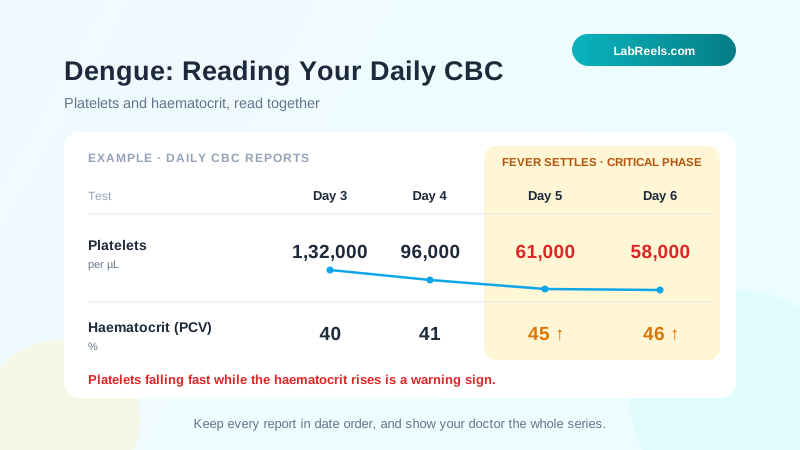
It is the fifth day of fever. Yesterday's report said 96,000 platelets. This morning's says 61,000, printed in bold with an "L" beside it. One relative is already phoning around for platelet donors, and another has arrived with papaya leaves.
Pause for a moment. A falling platelet count is an expected part of dengue, and most people with dengue get better in one to two weeks. The number matters, but India's national dengue guideline is blunt about its limits: "Platelet counts are unreliable to predict bleeding." Doctors read the platelet count together with the haematocrit printed beside it, the day of the illness, and how the person is actually doing.
This guide shows you how to read your daily CBC the way doctors do: what is normal, why platelets fall, which days carry the most risk, what platelet transfusions are really for, and which signs mean you should go to hospital now, whatever the report says.
If the person with dengue has any of the warning signs listed below, go to a hospital now. Do not wait for the next report.
Key Takeaways
- A normal adult platelet count is 1.5 to 4.5 lakh per µL. In dengue it commonly falls, and it often falls fastest as the fever settles, around days 3 to 7.
- India's 2023 national dengue guideline is clear: "Platelet counts are unreliable to predict bleeding." A low number on its own is not the emergency many families fear.
- Read the haematocrit (PCV) next to it. A haematocrit that keeps rising while platelets fall quickly is a warning sign of plasma leakage, the hallmark of severe dengue.
- The fever going away is not the all-clear. Severe dengue often begins after the fever has gone.
- Platelets are transfused for bleeding, not for a number. The guideline says to "transfuse platelet only if bleeding is present".
- For fever, use paracetamol as your doctor advises and avoid aspirin and other NSAIDs. Papaya leaf, kiwi and goat milk are not proven treatments.
What Is a Normal Platelet Count, and How Is It Written on Your Report?
A normal adult platelet count is 1.5 to 4.5 lakh per microlitre (µL). The US National Heart, Lung, and Blood Institute puts it at 150,000 to 450,000 platelets per microliter of blood. Labs print slightly different upper limits, so read your result against the range on your own report. For a refresher on what platelets do, see the platelet section of our CBC guide.
The same count can be printed in several ways, which confuses many families in the middle of a dengue scare. All of these mean exactly the same result:
| What your report shows | Unit printed beside it | Platelets per µL |
|---|---|---|
| 61,000 | /µL or /cumm | 61,000 |
| 0.61 | lakh/cumm | 61,000 |
| 61 | 10³/µL (sometimes written 10^3/µL) | 61,000 |
| 61 | 10⁹/L | 61,000 |
A cubic millimetre (cumm or mm³) is the same volume as a microlitre, so a count "per cumm" and a count "per µL" are identical. If two reports use different units, convert before you compare. We explain how units change the numbers for every common test.
Why Do Platelets Fall in Dengue?
Platelets fall in dengue because the body makes fewer of them and destroys more of them at the same time. India's National Guidelines for Clinical Management of Dengue Fever 2023 say the precise mechanism is not known, but describe two main effects: the infection suppresses the bone marrow, where platelets are made, and the immune response destroys platelets, partly in the liver and spleen.
A falling count is so typical of dengue that the guideline lists low platelets in its clinical description of the disease. Seeing it on a report is expected. What matters is how fast it is falling, what the haematocrit is doing at the same time, and how the person is feeling.
When Does the Platelet Count Drop the Most?
The count usually falls fastest around the time the fever comes down, which is also when dengue is most likely to turn serious. The illness runs in three phases:
| Phase | When it happens | What the CBC often shows |
|---|---|---|
| Febrile (fever) phase | The first 2 to 7 days of fever | White cells and platelets start to fall |
| Critical phase | Usually begins after day 3 or 4 of fever, as the fever settles, and lasts about 24 to 48 hours | Platelets can fall quickly; the haematocrit rises if plasma is leaking |
| Recovery phase | After the critical phase, lasting 2 to 3 days | White cells rise first, then platelets climb gradually; the haematocrit settles |
The most important line in that table: the fever going away is not the all-clear. The World Health Organization notes that the symptoms of severe dengue often come after the fever has gone away. Only a minority of patients enter the critical phase, 5 to 10% according to the Indian guideline, but anyone who does needs close watching for those 24 to 48 hours.
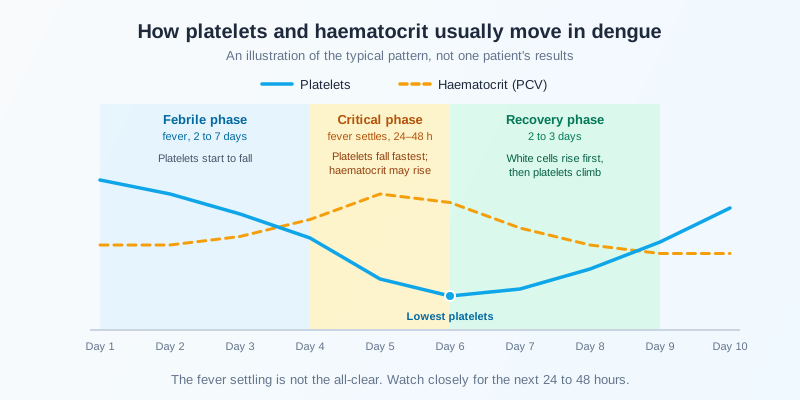
Recovery has its own pattern. The white cell count rises first and the platelet count follows gradually, so platelets can stay low for a few days even as appetite and energy return. The guideline also notes that the critical phase is commonly seen in people who have had dengue before, so tell the doctor if the person has had dengue in the past.
Why Does the Haematocrit Matter as Much as the Platelet Count?
The haematocrit, often printed as PCV or HCT, is the share of your blood made up of red cells. It is normally around 40 to 50% in men and 36 to 46% in women (see our CBC normal ranges). In dengue, it is an early clue on a blood report that plasma is leaking.
Here is why. In the critical phase, small blood vessels become leaky and the liquid part of the blood, the plasma, seeps out of them. The red cells stay behind, so the blood becomes more concentrated and the haematocrit rises. If enough fluid leaks out, blood pressure can drop into shock. The guideline calls plasma leakage "the distinguishing feature of severe dengue".
That is why doctors read the two numbers together. The guideline's list of warning signs includes a "progressive increase in haematocrit with a rapid decrease in platelet count", and it states that "a rising haematocrit of 10% above baseline is an early objective indicator of plasma leakage."
"Baseline" means the person's own earlier haematocrit, ideally from the first days of the illness. Keep every report in date order, and show your doctor the whole series, not just today's sheet.
| What the reports show | What it can mean | What to do |
|---|---|---|
| Platelets drifting down, haematocrit steady, person drinking and passing urine normally | The usual course of dengue | Keep to the tests and check-ups your doctor advised |
| Platelets falling fast while the haematocrit rises | A warning sign of plasma leakage | Contact your doctor straight away; the guideline manages warning signs with observation or admission in hospital |
| Haematocrit falling while the person is getting worse | Can mean hidden bleeding | Go to hospital now |
| Haematocrit settling, white cells and then platelets rising, appetite returning | Usually recovery | Continue follow-up until your doctor says you are clear |
Haematocrit readings are also affected by existing anaemia, bleeding and intravenous fluids, which is one more reason the series belongs in front of a doctor.
Is a Low Platelet Count Dangerous on Its Own?
Not by itself. "Platelet counts are unreliable to predict bleeding," says India's 2023 guideline. For a patient whose circulation is stable and who has only small red skin spots or mild gum bleeding, the guideline's treatment is supportive care: bed rest, enough fluids and monitoring.
That does not mean a very low count is ignored. Doctors treat the person, not the number: a falling count tells them to watch more closely, and bleeding or warning signs tell them to act. The guideline's discharge rules show the balance. A hospitalised patient goes home only when, among other things, the fever has been gone for at least 24 hours without fever medicine and the platelet count is above 50,000.
When Is a Platelet Transfusion Actually Needed?
Platelets are transfused for bleeding, not for a number. India's guideline puts it in one line: "Transfuse platelet only if bleeding is present." A preventive transfusion, given without bleeding, "may be considered" only when the count is below 10,000 per cumm or when the person may need emergency surgery. Elsewhere the guideline is just as plain: "Platelet transfusion is not recommended for thrombocytopenia (no prophylaxis platelet transfusion)."
The advice rests on evidence. In a randomised trial of 372 adults with dengue in Singapore and Malaysia, all with platelet counts of 20,000 or lower and none with persistent or severe bleeding, preventive transfusions did not significantly reduce bleeding: 21% of the transfused patients bled, against 26% of those given supportive care alone. The transfused group had 13 adverse events against 2, including three serious ones: anaphylaxis (a severe allergic reaction), lung injury and fluid overload. India's guideline cites this trial.
Unnecessary transfusions carry their own risk. The guideline lists "inappropriate transfusion of fresh-frozen plasma, platelet concentrates and cryoprecipitates" among the causes of fluid overload in dengue.
So a falling count alone is not a reason to start arranging donors. If a transfusion is suggested, it is fair to ask what it is for. There can be good reasons, such as bleeding, a procedure, or another medical condition, and your doctor can tell you which one applies.
Which Tests Confirm Dengue, and When?
The right test depends on the day of fever. India's guideline asks labs to use the NS1 antigen test for samples taken on days 1 to 5, and the IgM antibody test after day 5.
| Test | When it works best | What a positive result means |
|---|---|---|
| NS1 antigen (ELISA) | Days 1 to 5 of fever | Confirms dengue |
| IgM antibody (ELISA) | After day 5 | Confirms recent dengue. IgM usually appears by day 5 and fades by about 60 days in most people |
| IgG antibody | Two samples taken two weeks apart | A fourfold rise confirms dengue; one positive IgG on its own does not |
| Rapid "card" test (NS1, IgM or IgG) | Any day | Counts only as "probable" dengue |
Two practical points. First, a rapid card test from a neighbourhood lab is a starting point, not a diagnosis. The guideline treats a positive card test as "probable" dengue because of the tests' "poor sensitivity and specificity", and says the national programme "does not recommend the use of RDTs for diagnosis and guiding the management of Dengue fever cases." Second, a negative result from the wrong test for the day does not rule dengue out. Ask your doctor whether a repeat or a different test is needed.
Which Fever Medicines Are Safe in Dengue?
Paracetamol is the fever medicine for dengue. Aspirin and other NSAIDs are not. India's guideline advises paracetamol when the temperature goes above 100°F and says to "avoid using aspirin or NSAIDs". The WHO gives the reason: these drugs can increase the risk of bleeding.
NSAIDs include several everyday fever and pain tablets in India: ibuprofen, diclofenac, nimesulide, mefenamic acid and aspirin. Check combination tablets too, because many pair paracetamol with ibuprofen. Read the label, and ask the pharmacist if you are unsure. Use paracetamol exactly as your doctor advises, especially for children, whose dose depends on body weight.
If you take aspirin or another blood thinner for your heart, do not stop it on your own. Tell the doctor treating the dengue. The guideline asks doctors to monitor these patients carefully and leaves the decision to stop to them, based on the platelet count and any bleeding.
Alongside paracetamol, the guideline's home care is simple: plenty of fluids such as ORS or coconut water, no fizzy drinks, and bed rest.
Do Papaya Leaf, Kiwi or Goat Milk Raise Platelets?
None of them is a proven dengue treatment, and raising the platelet number is not the same as preventing severe dengue.
Papaya leaf has the most research behind it. A 2019 systematic review of nine studies, six of them from India, found that seven reported a rise in platelet counts with papaya leaf extract. But the evidence was rated low quality, there was no evidence at all on plasma leakage, serious complications or death, and the reviewers concluded that "current evidence is insufficient to comment on the role of CP extract in dengue." If you want to try it, tell your doctor, and never let it replace monitoring or fluids.
Kiwi is widely shared as a platelet booster, but we could not find a single clinical trial testing it in dengue. It is fine as food if the person feels like eating it, but it is not a treatment.
Goat milk has no trial evidence either, and raw goat milk carries a real risk. Doctors in Nepal have reported brucellosis, a separate bacterial infection, in a patient who drank raw goat milk to boost platelets during dengue. Their advice: "the milk must be properly boiled before use."
When Should You Go to Hospital Straight Away?
Go to a hospital immediately if the person with dengue has any of these signs, especially in the day or two after the fever settles. The list comes from India's national guideline:
- Severe stomach pain, or vomiting that will not stop
- Bleeding from the nose or gums, vomiting blood, black tarry stools, blood in the urine, or unusually heavy periods
- Red spots or patches on the skin
- Drowsiness, irritability, restlessness, or a sudden change in behaviour
- Fainting or giddiness
- Pale, cold or clammy skin
- Difficulty breathing
- Passing very little urine
- A report showing the haematocrit rising while the platelet count falls quickly
Some people should see a doctor early, even before any warning sign appears. The guideline lists risk factors for severe dengue, including:
- Babies and children under 10, especially if malnourished, and adults over 65
- Pregnancy, and women who are menstruating or have abnormal vaginal bleeding
- Obesity, diabetes, high blood pressure, heart disease, and chronic lung, kidney or liver disease
- Thalassaemia, G6PD deficiency or other blood disorders, and peptic ulcers
- Long-term steroid or painkiller (NSAID) treatment
The guideline places people with these risk factors in its "moderate dengue" group, which is managed with observation or admission in hospital.
Conclusion
In dengue, the platelet count is the number everyone watches, but it is not the number that decides how the illness goes. Read it as one part of a bigger picture: the day of the illness, the haematocrit printed beside it, and above all how the person is eating, drinking and behaving.
Keep every report in date order and take the whole series to your doctor. Use paracetamol, not aspirin or ibuprofen. Treat the day or two after the fever settles as the time to watch most closely, and remember that platelet transfusions are for bleeding, not for a number.
When a report is hard to make sense of late at night, upload your lab report on Labreels. A phone photo of the CBC is enough, and you get every value explained in plain English or Hindi, ready to discuss with your doctor.
Frequently Asked Questions
Q: What platelet count is dangerous in dengue?
There is no single number. India's national guideline says platelet counts are unreliable to predict bleeding, so doctors look at how fast the count is falling, the haematocrit, and warning signs such as bleeding, severe stomach pain or drowsiness. Without bleeding, a preventive transfusion is considered only when the count is below 10,000 per cumm or emergency surgery is needed, and the guideline's discharge criteria include a count above 50,000.
Q: How many days does it take for platelets to recover after dengue?
Platelets usually start rising in the recovery phase, once the critical phase has passed. India's guideline describes the white cell count rising first, followed by a gradual rise in platelets, over a recovery phase of about two to three days. If the count keeps falling after the fever has settled, or the person feels worse, see a doctor the same day.
Q: The fever has gone. Is the danger over?
Not yet. The World Health Organization notes that the symptoms of severe dengue often come after the fever has gone away. The critical phase usually starts as the fever settles and lasts about 24 to 48 hours, so keep watching for warning signs and keep up the tests your doctor advised during that time.
Q: Should we arrange a platelet transfusion if the count falls below 20,000?
Not routinely. A randomised trial in adults with counts of 20,000 or lower found that preventive transfusions did not significantly reduce bleeding and were linked to more adverse reactions. India's guideline says to transfuse platelets only if bleeding is present, and to consider a preventive transfusion only below 10,000 or before emergency surgery.
Q: How often should the CBC be repeated in dengue?
As often as your doctor advises. India's guideline recommends a CBC with haematocrit and platelet count for everyone whose fever has lasted more than three days and for anyone with warning signs. In hospital during the critical phase, the haematocrit is checked at least every four to six hours in stable patients, and more often in unstable ones.
Q: Is the dengue rapid card test reliable?
Not on its own. India's national programme does not recommend rapid card tests for diagnosing dengue or guiding treatment, and counts a positive card test only as "probable" dengue. An ELISA-based NS1 test (days 1 to 5) or IgM test (after day 5) is needed to confirm it.
Q: Does papaya leaf juice increase platelets in dengue?
Some small studies show a rise in platelet counts with papaya leaf extract, but a 2019 systematic review rated the evidence low quality and found no evidence on whether it prevents plasma leakage, complications or death. If you want to use it, tell your doctor, and do not let it replace monitoring and fluids.
Q: Can I take ibuprofen or a combination fever tablet for dengue?
No. Ibuprofen and other NSAIDs, including aspirin, can increase the risk of bleeding in dengue, and India's guideline says to avoid them. Many combination tablets contain ibuprofen alongside paracetamol, so check the label. Use plain paracetamol as your doctor advises.
This guide summarises India's National Guidelines for Clinical Management of Dengue Fever 2023, WHO guidance and published research for general information. It is not a substitute for advice from a doctor who has examined the patient.